The lunar halo was observed by people before they had come up with any explanation about the causes for its “appearance”. Today, we know that it is caused by the phenomenon of light refraction.
In 1666, when Isaac Newton discovered that light passing through a diaphragm and then through a crystal prism turns into a set of coloured bands as it does in a rainbow, he opened a gate into a different realm of science. A beam of light passing through a glass prism has opened the way to discovering the composition of the earth, the solar system and the stars through what we now call spectroscopy.
The spectrum, meaning the set of coloured bands observed by Newton, today allows astronomers to obtain a wealth of information about the cosmic body studied, such as the distance at which it lies, its chemical composition, its age, the history of its formation, its temperature etc.
What would it be like if you looked at the starry sky through a special eye made up of a type of prisms that separate the colours of the light emitted by the stars?
The prisms used today can be made of glass or any other transparent polymer, depending on the purpose for which it is to be used.
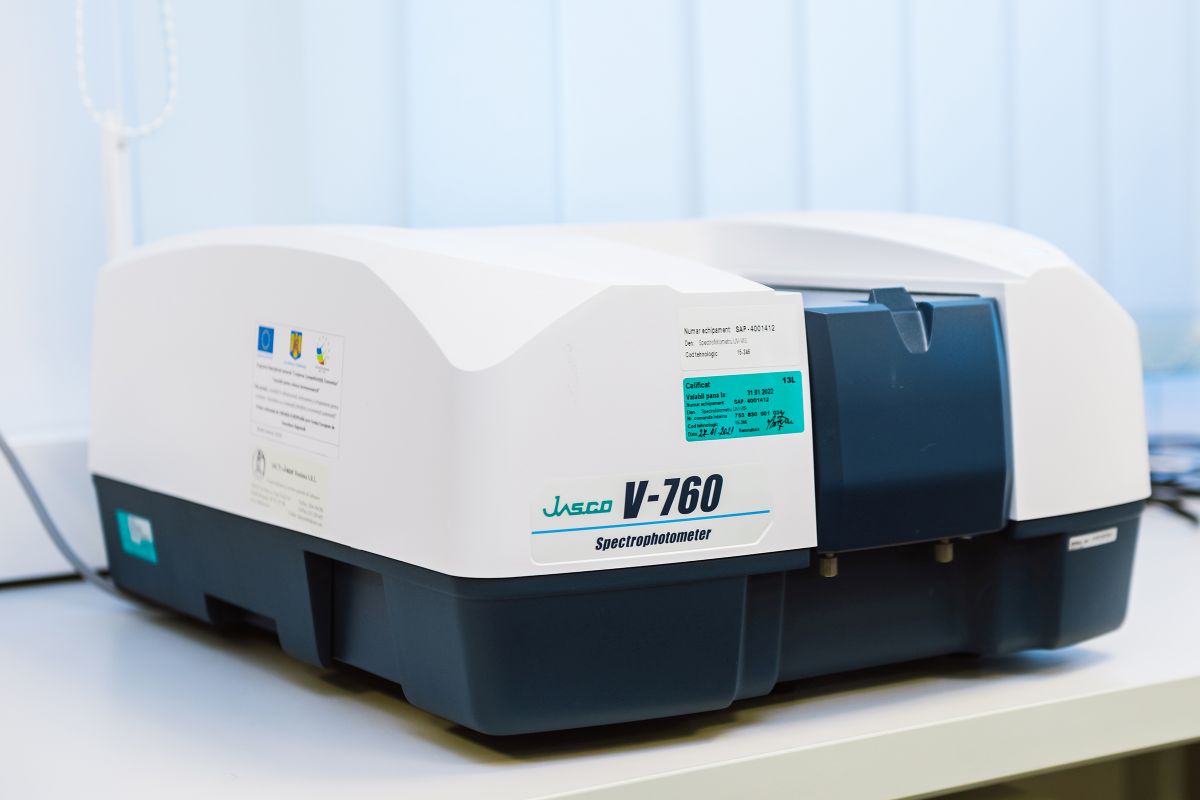
The property of substances to only partially absorb the light thus decomposed, meaning only certain wavelengths, help us in chemistry and pharmacy to be able to identify the substance in question and determine its purity. This method is used both in determinations using colorimetry or spectrophotometry and in state-of-the-art chromatography devices as well, where the difference in fact lies in separating the compounds before qualitative and quantitative determinations.